Business Awards in India 2026: Types, Credibility & Practical Guide

TLDR
Business awards in India recognise companies, founders, MSMEs, startups, and professionals for achievements like growth, innovation, leadership, and social impact. Not all awards carry the same weight. Credibility depends on the selection process, evidence requirements, jury transparency, and fee structure, not the trophy design. This guide defines the key terms, explains how different award types work, and gives you a practical framework for choosing and using business recognition responsibly.
What Are Business Awards in India?
Business awards in India are recognition programs that honour companies, entrepreneurs, founders, MSMEs, startups, corporate leaders, teams, or professionals for measurable achievements. These achievements might include revenue growth, innovation, customer impact, quality, sustainability, governance, or sector excellence.
The term covers a wide range. A government-backed MSME award, a media-led corporate award, an independent national recognition, and a paid event trophy can all fall under the same umbrella. They differ sharply in eligibility, judging rigour, credibility, cost, and marketing value.
India’s business base is enormous, which explains why the awards space is so crowded. The official Udyam Registration dashboard shows over 9.96 crore total registrations source. DPIIT-recognised startups crossed 2.23 lakh as of March 2026, with more than 55,200 startups recognised in FY 2025-26 alone source. That scale creates genuine demand for recognition, but it also makes credibility checks essential.
If your business has strong, evidence-backed achievements, explore the National Business Awards categories to find one that fits your strongest proof.
Why Business Awards Matter
Awards are signals, not proof of superiority. That distinction matters.
A 2024 study in the Journal of Industrial Economics found that winning a major prize increased sales, reviews, and word of mouth, consistent with prizes acting as quality signals and coordination devices source. The effect is real, but it depends on the credibility of the award itself.
For Indian businesses, a credible award can support trust with customers, improve hiring conversations, strengthen investor updates, boost internal morale, and provide useful PR material. None of these outcomes are guaranteed. They follow from the award’s reputation, the specificity of the category, and how accurately the winner describes the recognition afterward.
The practical question is never “should I win an award?” It is “which award matches my evidence, and will the recognition be taken seriously by the audience I care about?”
Main Types of Business Awards in India
Business awards in India fall into several categories. Understanding the differences helps you avoid wasting time and money on the wrong program.
Government Business Awards
These are run by government departments or official initiatives. They typically have strict eligibility, formal documentation requirements, and strong credibility in procurement, policy, and ecosystem contexts.
The Ministry of MSME’s National MSME Awards cover manufacturing entrepreneurship, service entrepreneurship, and special categories (including women, SC/ST, and Divyang entrepreneurs), with 35 total awards across these groups source. The National Startup Awards, run through Startup India and DPIIT, require DPIIT recognition and cover 20 sectoral categories plus special award categories source.
Government awards carry weight. But eligibility is narrow, documentation is heavy, and competition is intense.
Established Media and Industry Body Awards
Business media brands, chambers of commerce, and industry associations run award programs that combine visibility with sector relevance. Examples include Economic Times category awards, EY Entrepreneur Of The Year (launched in India in 1999, now in its 28th edition) source, FICCI awards, CII programs, and Golden Peacock Awards.
These carry strong brand recognition but may have higher entry demands, fees, and competition.
Independent Awards
Independent awards are not government-run but can still be credible when they publish eligibility, criteria, scoring logic, and event details transparently. National Awards India, for instance, is an independent recognition initiative with a published 100-point evaluation methodology, pan-India eligibility, and multiple sector-focused programs. It is not a Government of India award.
You can review the full list of programs to see how categories span business, startups, leadership, education, healthcare, innovation, and social impact.
Promotional and Event-Led Awards
Some awards primarily offer stage time, media visibility, networking, and trophy packages. These can be useful for marketing if the audience fit is genuine. Credibility depends heavily on transparency. If the process is unclear, the value is mostly promotional.
Vanity and Pay-to-Collect Awards
These programs look prestigious but provide little independent assessment. Common signs include unsolicited “you have been selected” emails, no public criteria, no named jury, payment required to receive the trophy, and grand-sounding titles without ecosystem recognition.
Practitioners on Reddit consistently flag this as the central problem in the Indian business awards space. One detailed post in r/AllIndiaStartups argues that most awards fall into two buckets: genuinely prestigious awards that open doors, and pay-to-play vanity programs where recipients essentially buy visibility source. The practical test suggested by founders is simple: does winning open a door that was previously closed?
Business Awards Glossary: Key Terms Explained
If you are applying for business awards in India for the first time, the terminology can be confusing. Here are the terms that matter most.
Nomination
The act of putting forward a person, company, team, or project for an award. Some awards allow self-nomination; others require third-party nomination or editorial shortlisting. Self-nomination is common and legitimate when the award openly allows it. It becomes questionable only when the process suggests a win is guaranteed.
Award Category
A specific recognition area within an award program, such as “Startup of the Year,” “Best MSME,” “Women Entrepreneur,” or “Innovation Excellence.” Category choice often makes or breaks an application. A strong nomination matches your best evidence to a fitting category, not the most impressive-sounding one.
Eligibility Criteria
The rules that determine who can apply. Examples include company age, location, revenue size, sector, incorporation status, founder profile, evaluation period, and operational presence. Always check these before investing time in an application.
Evaluation Period
The time window during which the achievements being submitted must have occurred or remained active. For example, the ET Maharashtra Business Awards specifies that submitted work must be ongoing between defined dates for that edition source.
Evaluation Rubric
A scoring framework that explains how nominations are judged. Rubrics reduce uncertainty. They help applicants know whether to emphasise growth, innovation, leadership, impact, consistency, or evidence quality. You can see how this works in practice by reviewing the published selection methodology used by National Awards India, which breaks evaluation into weighted criteria across impact, quality, leadership, consistency, contribution, and integrity.
Jury
A group of people who review nominations and select finalists or winners. A good jury should have relevant experience, independence, and sector understanding. If the jury is not named and the process is vague, ask questions before paying or applying.
Finalist / Shortlist
A nominee selected for the final stage before winners are announced. In many credible awards, finalist status itself carries PR value. A National Startup Awards 5.0 finalist shared on LinkedIn that being shortlisted from a nationwide pool felt like validation, even without ultimately winning source.
Due Diligence
Checks performed by the organiser to verify claims, documents, eligibility, and evidence. Due diligence protects award credibility and reduces the risk of false claims making it through.
Supporting Evidence
Documents or proof submitted with a nomination. These might include revenue records, customer testimonials, case studies, patents, product screenshots, audit reports, impact data, or compliance documents.
Winner Package
Benefits offered to winners, such as a trophy, certificate, stage felicitation, media coverage, logo or badge, website listing, interview, or networking access. Ask what is included and whether usage rights are clear before applying.
How Credible Business Awards Are Usually Judged
Not all business awards in India follow the same process, but credible programs tend to share common stages:
Eligibility screening. Applications checked against published rules.
Category matching. Nomination reviewed for fit with the selected category.
Document and evidence review. Supporting materials examined for substance.
Scoring or jury review. Evaluation against defined criteria or rubric.
Shortlist and finalist selection. Top-scoring nominations advanced.
Due diligence. Claims verified where possible.
Winner announcement and ceremony. Recognition at an event or through public communication.
FICCI’s quality awards process includes document assessment, site audits for shortlisted units, jury finalisation, and applicant feedback source. Golden Peacock Awards describes a process where professional independent experts evaluate applications before shortlisted applicants proceed to a jury source.
The key takeaway: if an award program cannot explain its evaluation process, that is a red flag.
What Evidence Strengthens a Business Award Nomination?
A strong nomination is not “we are the best.” A strong nomination is “here is what changed, how we know it changed, and what evidence proves it.”
Evidence type
What to submit
Best for
Growth evidence
Revenue growth, customer growth, market expansion, new locations
Business excellence, MSME, startup awards
Customer evidence
Testimonials, reviews, retention rates, case studies
Service excellence, sector awards
Innovation evidence
Product demos, patents, process improvements, technology adoption
Innovation, startup, technology awards
Leadership evidence
Team growth, strategic decisions, turnaround stories
Leadership, entrepreneur, CEO awards
Impact evidence
Jobs created, environmental savings, social outcomes
Social impact, CSR, changemaker awards
Quality evidence
Certifications, SOPs, audit results, compliance records
Quality, manufacturing, healthcare awards
Consistency evidence
Multi-year performance, repeat outcomes, long-term relationships
Mature business, corporate awards
Public proof
Media coverage, third-party reports, partnerships
PR and credibility validation
Practitioners on Reddit note that many smaller awards are won through a well-written application and a credible story. The advice from small-business founders is consistent: clear storytelling with metrics and third-party proof beats a data dump every time.
Ready to prepare your nomination? Start your application after matching your evidence to the right category.
Free, Paid, and Participation-Based Awards: What Is the Difference?
This is where confusion runs deepest. The presence of a fee does not automatically disqualify an award, but the structure and transparency of fees matter.
Entry fee. A fee paid to submit an award entry. Entry fees can fund administration and judging infrastructure.
Verification fee. A fee charged for checking submitted claims or documents. Some programs, like FSIA’s Forever Business Awards, list a fee of Rs 2,999 described as a verification and application charge.
Event attendance fee. A fee for attending the ceremony, receiving a package, or collecting certain benefits.
Paid recognition. Recognition where payment is directly tied to visibility, a feature, or award receipt. Paid recognition may have marketing value, but it should not be described as a purely independent judgement unless the process genuinely supports that claim.
The important point is not “fees are bad.” It is that fee transparency matters. Ask what you are paying for, what is included, and whether the fee affects your chances of winning.
Award programs at the higher end of the credibility spectrum, such as Golden Peacock, publish fee structures openly. Their ESG award, for instance, lists an application fee in the tens of thousands plus GST. The transparency itself is a trust signal.
How to Check If a Business Award Is Credible
Before applying for any business award in India, run through these ten checks.
Is the organiser identifiable? Check the legal entity, website, contact details, and track record. Reviewing past events and ceremonies of any award program gives you a concrete sense of its history.
Is the award government, industry, media, independent, or promotional? Do not assume “national” means government-backed.
Are eligibility rules published? Look for company age, sector, revenue, geography, and required documents.
Are categories specific? A precise category is usually more credible than a vague “best business” label.
Is the jury or evaluation process disclosed? Named juries, published criteria, and review stages are stronger signals.
Is evidence required? Strong awards ask for metrics, proof, and examples.
Are fees disclosed? Ask whether fees cover entry, verification, event attendance, winner packages, or award collection.
Are past winners real and verifiable? Search winners online. Check whether they are credible companies or unknown names with no trace.
Can you accurately describe the award later? Avoid applying if the award title will tempt you to make unsupported “India’s best” claims.
Does the award create useful outcomes? Good outcomes include PR, customer trust, recruitment, investor updates, morale, or procurement credibility. A trophy alone is not enough.
Reddit discussions repeatedly circle back to one pragmatic question: does the award open a real door? If it helps with customers, investors, hiring, procurement, or genuine credibility, it is worth pursuing. If the only tangible output is a photograph with a trophy, think twice.
Why Applicants Are Sceptical, and What Credible Awards Do Differently
Marketing discussions on Reddit and LinkedIn reveal a consistent pattern. Applicants dislike awards that feel pre-decided. They distrust hidden juries and unclear fees. They care about practical outcomes.
One marketing thread notes that awards are worth pursuing when they come from a reputable organisation, but warns that many programs amount to pay-to-play. The dividing line, according to practitioners, is process. Red flags are almost always process-related, not name-related: no public jury, unclear criteria, unsolicited “pre-selected” emails, required payment to collect trophies, and winners announced before judging ends.
Credible awards counter this scepticism by publishing their methodology upfront. National Awards India, for example, uses a documented 100-point rubric that weights impact, quality, innovation, leadership, consistency, contribution, and evidence integrity.
How to Use Business Awards in Marketing Without Misleading Customers
Winning a business award in India is one thing. Talking about it accurately is another.
ASCI (the Advertising Standards Council of India) has specific guidelines for using awards and rankings in advertisements source. Here are the key rules in plain English:
Mention the source and date. Ads referring to an award should clearly state the awarding organisation and the month or year of the award.
Respect the validity window. For annual awards, the recognition should generally relate to a period not more than 12 months before the advertisement, unless longer validity is substantiated.
Do not stretch the scope. A city-level or category-specific award should not be used to claim “India’s best.” ASCI explicitly says awards based on surveys in one area cannot be extrapolated to a larger territory.
Photos are not enough. Trophy photos, certificates, or event pictures are not sufficient by themselves. Advertisers may need to show the awarding process.
Disclose conflicts. ASCI expects no direct or indirect payment from the advertiser to the institution granting the award when the award is used as an advertising claim.
Safer vs Riskier Claim Wording
Risky claim
Safer version
“India’s best company”
“Winner, [Award Name], [Category], [Year]”
“No. 1 startup in India”
“Recognised as [Category] winner at [Award Program]”
“National award winner” (when not government-backed)
“Winner at [program name], an independent pan-India recognition initiative”
If you paid to enter, attend, or receive an award, be especially careful about using it as a superiority claim. It may still work as a factual recognition statement, but the wording should be accurate: organiser name, category, year, and scope.
For clarity on the distinction between government and independent recognition, the About page of National Awards India explicitly states its independence from the Government of India.
How to Choose the Right Award Category
Many applicants default to the biggest-sounding category. That is a mistake. Start with evidence instead.
Step 1: Claim. What achievement can you honestly claim?
Step 2: Evidence. What proof do you have?
Step 3: Category. Which category best matches that proof?
A few examples:
If your strongest proof is revenue and customer growth, choose a business excellence or growth category.
If the strongest proof is a new product or process, choose innovation awards.
If the strongest proof is founder resilience and vision, choose entrepreneur awards.
If the strongest proof is women-led impact, choose a women entrepreneur or women achiever category.
If the strongest proof is public benefit, choose social impact or changemaker categories.
A LinkedIn post about the National Startup Awards noted that more than 3,200 startups applied and only 20 received national honours. The founder used the applicant pool size as a credibility point. That ratio matters. Ask award organisers how many applicants entered, how many finalists were shortlisted, and how many winners were selected.
Nomination Readiness Checklist
Before you submit any application for business awards in India, confirm you can check every box:
I know the exact category I am applying for.
I meet the published eligibility criteria.
I have 3 to 5 measurable outcomes to present.
I have documents or proof to support each claim.
I can describe my impact in plain language, not just jargon.
I understand the fees and what they include.
I know how the winner can use the award badge or title.
I can describe the award accurately in marketing.
I have checked past winners of this program.
I have reviewed the evaluation criteria.
Examples of Business Award Programs in India
Award type
Example
Useful for
Government startup award
National Startup Awards (DPIIT)
DPIIT-recognised startups with defined category fit
Government MSME award
National MSME Awards (Ministry of MSME)
MSMEs with formal registration and documentation
Entrepreneur award
EY Entrepreneur Of The Year India
Founder-led businesses with scale and track record
Governance and quality award
Golden Peacock Awards (IOD, est. 1991)
Larger organisations focused on governance, ESG, quality
Industry body award
FICCI Quality Systems Excellence Awards
Sector-specific applicants with quality systems
Business media award
ET category awards
Regional and sector visibility
Independent multi-sector award
National Awards India
Businesses, leaders, startups, educators, creators, changemakers across India
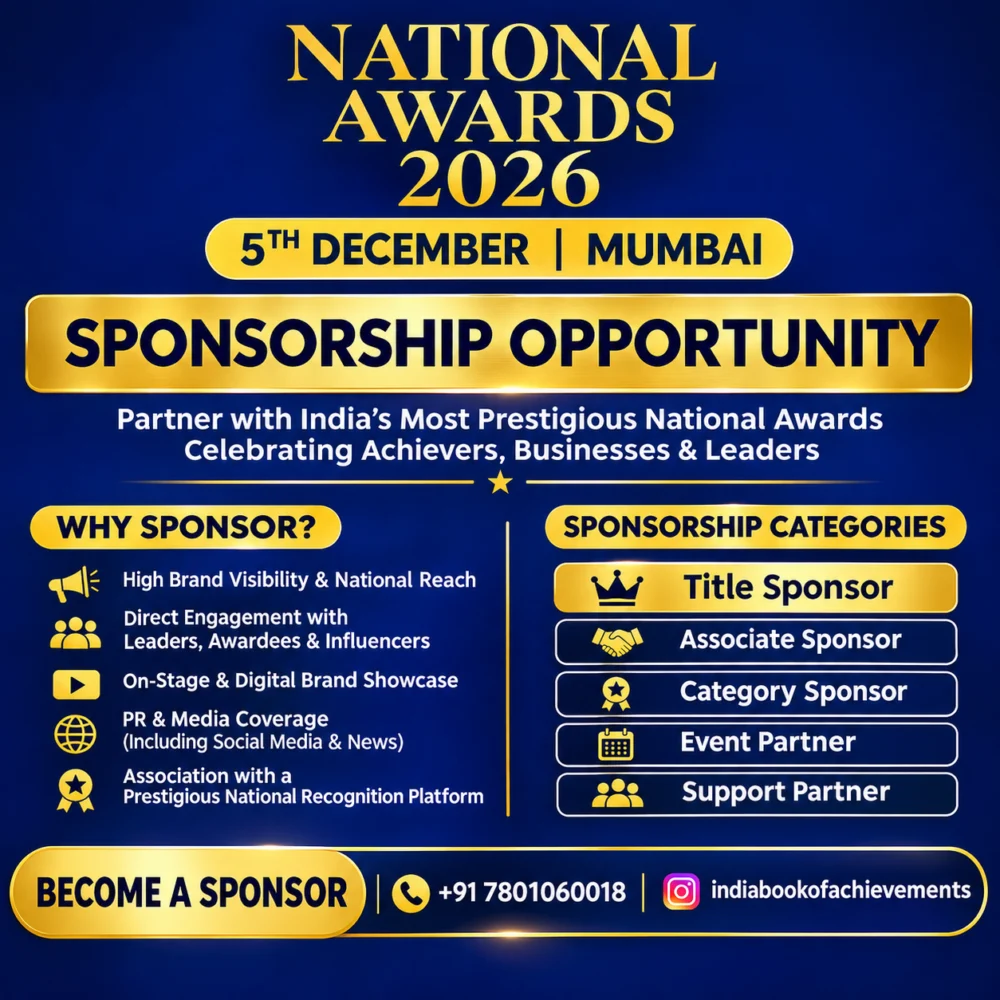
National Awards India runs multiple award programs spanning business, startups, leadership, entrepreneurs, corporate, women, creators, healthcare, education, media, innovation, and changemakers. The next edition is scheduled for Mumbai on December 5, 2026.
Explore the National Awards 2026 edition to find the category that matches your evidence.
Frequently Asked Questions
What are business awards in India?
Business awards in India are recognition programs that honour companies, founders, MSMEs, startups, leaders, and professionals for achievements such as growth, innovation, quality, leadership, sustainability, or social impact. They can be run by government bodies, media groups, industry associations, or independent platforms.
Are business awards in India the same as government awards?
No. “National” does not automatically mean government-backed. Some business awards are run by government ministries (like the National MSME Awards or National Startup Awards), while others are independent, media-led, or event-based. Always check the organiser’s identity and stated positioning.
Can startups apply for business awards?
Yes. Many business awards in India accept startup applications. Government programs like the National Startup Awards require DPIIT recognition. Independent programs like National Awards India accept self-nominations from startups with measurable achievements.
Are paid business awards credible?
It depends on what the fee covers and how transparent the process is. An entry or verification fee that funds administration is different from a payment that guarantees a trophy. Ask about the evaluation process, jury, past winners, and whether payment is tied to winning.
What documents do I need for a business award nomination?
Common requirements include revenue or growth records, customer testimonials, case studies, product or service proof, certifications, media coverage, patents, and impact data. The exact documents vary by award and category.
Can I nominate my own business for an award?
Yes. Self-nomination is standard practice across many award programs in India. It is only a concern if the program implies that every self-nominated applicant wins.
How should I mention an award on my website or advertisement?
Always include the organiser name, specific category, and year. Do not stretch a category-level or regional award into a broader “India’s best” claim. Follow ASCI guidelines, especially regarding fee-based recognition and geographic extrapolation. If you have questions about eligibility or categories, contact the team for guidance.
How do I choose the right award category?
Start with your strongest evidence, not the most impressive-sounding category name. Match your proof (growth, innovation, leadership, impact) to the category that best fits it. A well-matched application with strong evidence consistently outperforms a prestigious-category entry with weak proof.
Business Awards in India: programmes, eligibility and nominations
For the current Mumbai edition, review the National Business Awards 2026: eligibility, categories and nominations. To prepare an entry, follow the business awards nomination guide covering documents and application steps. You can also explore startup recognition programmes or see National Awards 2026 Mumbai event details. The National Awards India selection methodology explains the independent evaluation approach.